
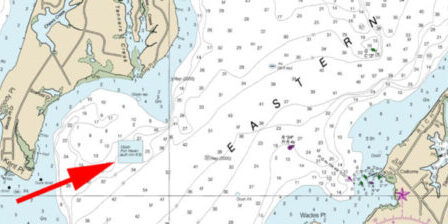
Hollicutt’s Noose Reef at the southern tip of Kent Island in Eastern Bay, Maryland, is one of the most enduring artificial reef sites in the Chesapeake Bay, serving as a model for habitat enhancement and ecosystem management. Originally permitted in 1966, the reef has seen decades of development, with materials first placed in 1968 and continuing through 2004. These early deployments consisted of concrete rubble, tire units, and other structures intended to provide shelter and feeding areas for fish and invertebrates. Over time, the reef has been upgraded with reef balls and other three-dimensional structures, enhancing the complexity of the habitat and supporting a thriving marine ecosystem.
Key partners in Hollicutt’s Noose Reef restoration include the Maryland Department of Natural Resources (DNR), Coastal Conservation Association (CCA) Maryland, and Maguire Marine. Together, these organizations have employed a variety of restoration techniques, from the placement of reef balls to the arrangement of tire units and other structures that mimic natural reef habitat. These efforts not only increase fish and invertebrate populations but also provide critical nursery and shelter habitat for species including striped bass, white perch, croaker, and catfish, while improving the local ecosystem by stabilizing sediments and supporting biodiversity. The site has also become a focal point for monitoring and community engagement, demonstrating the impact of long-term, science-driven reef management.
Building on this strong foundation, restoration efforts in 2024 included the deployment of 140 reef balls over firm bottom in 17 feet of water, arranged to enhance habitat complexity and provide elevated, structured areas that protect young fish and oysters. These reef balls create interstitial spaces that attract fish, crabs, and other aquatic species, supporting a multi-species ecosystem. Community involvement has been integral, with volunteers participating in the construction and deployment of reef balls, reflecting a strong culture of stewardship and hands-on engagement in habitat restoration.
The ongoing work by DNR, CCA Maryland, and other partners represents a continuation of decades-long efforts to restore the Eastern Bay and the Chesapeake Bay as a whole. Beyond boosting fish and invertebrate populations, these projects contribute to water quality, sediment stabilization, and biodiversity. As the reef structures mature, they form complex three-dimensional habitats that sustain marine life and serve as vital ecological infrastructure for the bay. This long-term, collaborative approach underscores how careful planning, scientific expertise, and community engagement can work together to restore and maintain healthy bay ecosystems.
Want to fish Hollicutt’s Noose Reef?
Below is an article by FishTalk that highlights recent reef deployments in Eastern Bay and their impact on local fisheries. The reef’s diverse structure attracts a variety of species, making it a productive spot for recreational anglers. Recommended launch areas include nearby Kent Island access points, and anglers can target striped bass, white perch, croaker, and catfish near the reef’s structures, where the combination of habitat and water flow concentrates fish.
Middle Chesapeake Hotspot: Holaga Snood???(opens in new tab)
Though it may have the oddest name of any fishing reef in the Bay, this Middle Chesapeake hotspot is one to take note of.
Credits
Image and Content Credit from: Maryland DNR, FishTalk, Wayne Young, Coastal Media, Will Parson/Chesapeake Bay Program, University of Florida, ReefBall, Sunset – Eastern Bay 7 by Nora Lives, own work, licensed under CC BY-SA 3.0