
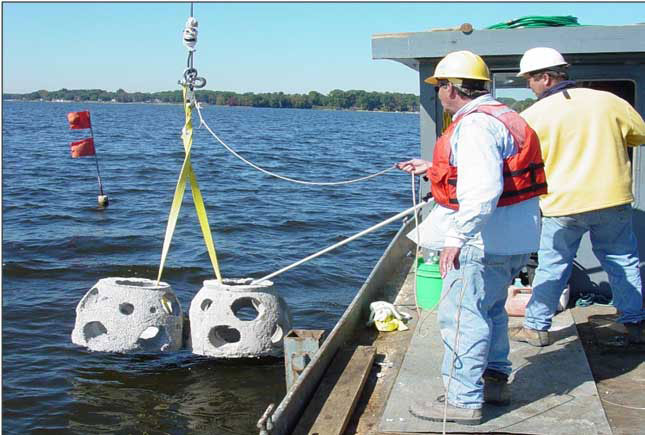
The Magothy River’s Noah’s Reef in Maryland is one of the most meaningful community-driven oyster restoration sites in the Chesapeake Bay, designed to honor the memory of Noah Anderson while serving as a model for habitat creation and stewardship. Established in 2021 through a partnership of local organizations, the reef was built using reef balls—concrete dome structures that provide durable, three-dimensional habitat for oysters and fish. The site, located just south of Dobbins Island, has since become an active focal point for restoration, conservation, and environmental education. By 2023, more than 175 reef balls had been deployed, with additional deployments in 2024 expanding the reef’s footprint to hundreds of units across several acres of river bottom. These efforts not only commemorate Noah’s life and love of the water but also contribute directly to the health and resilience of the Magothy River.
Key partners in the creation and growth of Noah’s Reef include the Coastal Conservation Association Maryland (CCA Maryland), the Magothy River Association, and the Living Reef Action Campaign (LRAC). Together, these groups have worked with schools, Eagle Scouts, local volunteers, and community organizations to construct and deploy reef balls throughout the river. Each reef ball functions as a settlement site for oyster spat, protecting juvenile oysters from sedimentation and predators while offering interstitial spaces for fish, crabs, and other aquatic organisms. This three-dimensional reef structure not only accelerates oyster growth but also improves biodiversity and water quality through the oysters’ natural filtration capacity.
Community engagement has been central to the project. Volunteers have participated in reef ball construction events at schools, libraries, and community centers, directly tying local residents to the long-term restoration of their river. Students in particular have had opportunities to mix, pour, and mold reef balls, learning firsthand about oyster ecology, habitat loss, and restoration science. Annual deployment events bring together families, conservationists, and watermen, reinforcing the link between environmental stewardship and cultural traditions tied to the Chesapeake Bay.
The ongoing expansion of Noah’s Reef reflects both the determination of its community partners and the urgent need to restore lost oyster habitat. By combining science-based restoration with grassroots involvement, the project contributes to improved water clarity, stronger fish populations, and a healthier Magothy River ecosystem. As the reef matures, it will continue to serve as a living tribute to Noah Anderson, ensuring his memory is celebrated through an enduring legacy of conservation, education, and connection to the Bay.
Want to fish Noah’s Reef?
Anglers venturing into the Magothy River will find that the reef ball sites offer both structure and opportunity. According to FishTalk, clusters of reef balls set off Rock Point rise 2½ to 3 feet from the bottom and span areas 100 to 120 feet wide in 9–11 foot waters. The article notes that on side-scan sonar, these reefs often appear as well-defined structures with marine growth, and schools of fish working the reef edges are visible as movement around the modules. FishTalk suggests that once you identify these reef clusters on your sonar or chart, it’s ideal to bounce jigs near the bottom or swim lures through the column above the structure—especially where bait and predatory fish congregate.
Magothy River Reefs(opens in new tab)
Stripers gather to hunt bait around these Upper Bay tributary reefs.
Credits
Image and Content Credit from: Maryland DNR, Chesapeake Bay Foundation, FishTalk, Wayne Young, Jaboyce (via Wikimedia Commons, CC BY-SA 4.0).