
Atlantic Menhaden Addendum II: A Critical Decision for the Chesapeake Bay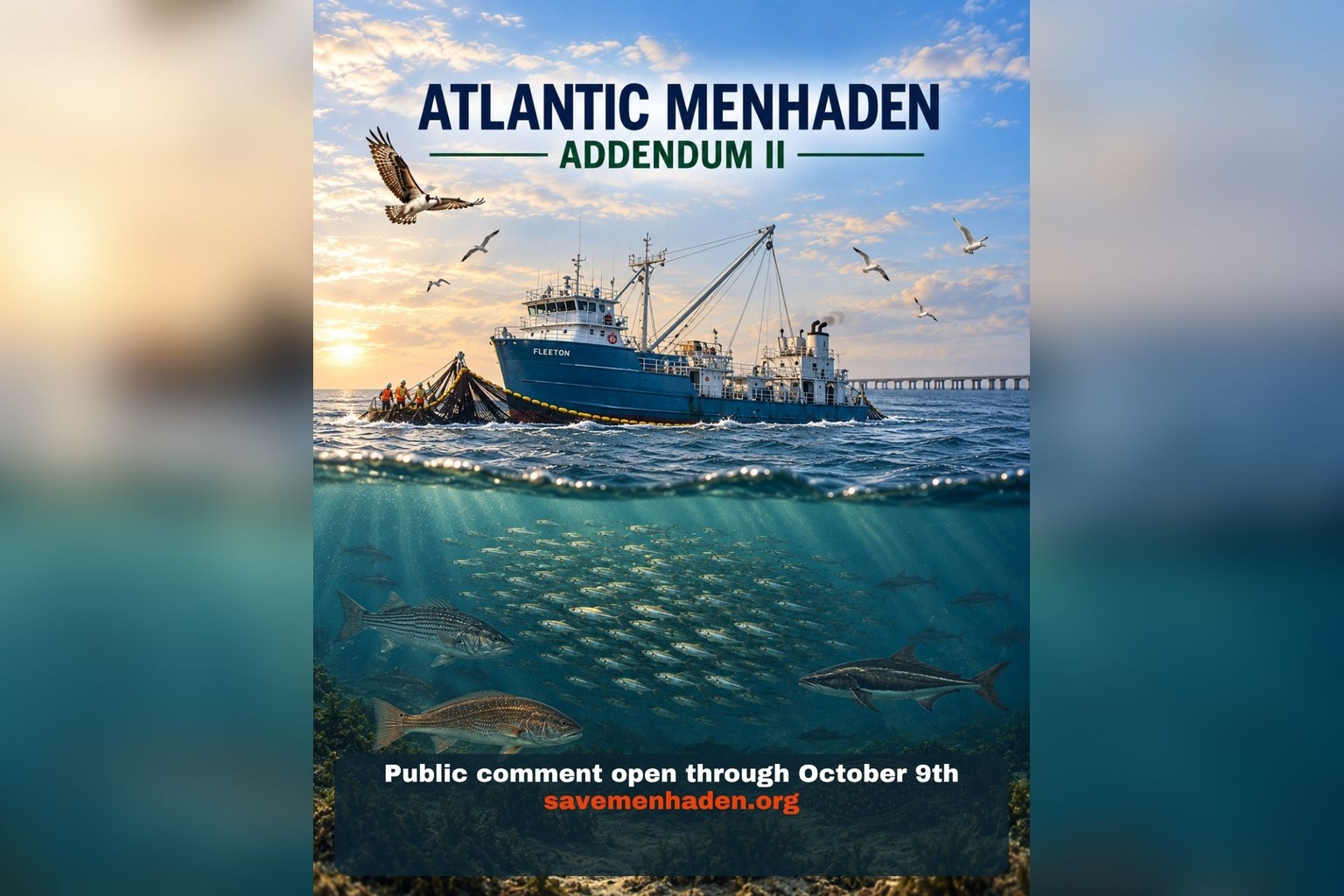
TAKE ACTION TODAY!
The Atlantic States Marine Fisheries Commission is accepting public comments on Draft Addendum II to the Interstate Fishery Management Plan for Atlantic Menhaden. The proposal considers several important changes to the management of the industrial reduction fishery in the Chesapeake Bay.
Atlantic menhaden are a foundational forage fish. Striped bass, osprey, cobia, red drum, bluefish, dolphins, whales, and many other predators depend on menhaden as a source of food. Ensuring that enough menhaden remain available in the water is essential to the health and productivity of the Chesapeake Bay and the broader Atlantic ecosystem.
Public comments on Draft Addendum II must be submitted by 11:59 p.m. on October 9, 2026.
Why Is ASMFC Considering This Action?
The Atlantic States Marine Fisheries Commission initiated Draft Addendum II after nearly two years of discussion about the ecological condition of menhaden in the Chesapeake Bay.
Several warning signs have contributed to the need for action:
- Declining catch rates and landings in the Chesapeake Bay pound-net fishery.
- Unprecedented osprey nesting failures in saltier portions of the Bay, where research has linked poor reproductive success and food stress to limited menhaden availability.
- Continuing gaps in Chesapeake Bay-specific menhaden abundance and ecological data.
- Results from the 2025 menhaden stock assessments, including ecosystem-based analysis showing that additional coastwide harvest reductions were necessary to meet established ecological management objectives.
Last Fall, the ASMFC failed to reduce the coast wide total allowable catch to maintain their commitment to ecosystem based management. The commission chose to reduce 2026 harvest caps by 20% rather than the 54% that the best available science advised. This puts the menhaden behind the proverbial 8-ball once again, and we all know what happens when the bait is gone.
Businesses, livelihoods, communities and much more has been long impacted by high volume industrial removals of menhaden from the Chesapeake Bay. The Board will have a chance to act this November on the items listed in the addendum, as well as 2027 catch limits coast wide. Will the follow the science, or continue to abandon ecosystem based management for Atlantic menhaden management, the first, and once heralded management approach.
Draft Addendum II now provides an opportunity to address the amount, timing, and concentration of industrial menhaden harvest within the Chesapeake Bay, yet many fear this action nor the commission will go far enough.
What Is the Chesapeake Bay Cap?
The Chesapeake Bay Cap limits the amount of menhaden that the industrial reduction fishery may harvest from the Bay. The current cap is 51,000 metric tons.
The Bay Cap does not reduce the reduction fishery’s overall coastwide allocation. Menhaden not harvested inside the Chesapeake Bay may still be harvested from other areas as part of the fishery’s allowable catch.
A more precautionary Bay Cap would help leave additional menhaden within the Chesapeake Bay ecosystem while allowing the reduction fishery to continue operating outside the Bay.
What Would Draft Addendum II Change?
Draft Addendum II presents several management decisions for public comment.
1. The Amount of the Chesapeake Bay Cap
ASMFC is considering maintaining the current 51,000-metric-ton cap or reducing it by 10%, 20%, 30%, or 50%.
The Commission is also considering linking the Bay Cap to the coastwide total allowable catch. Under this approach, the cap would be established as a percentage of the coastwide quota and could adjust when that quota changes.
2. Upper and Lower Limits
If the Bay Cap is linked to the coastwide quota, ASMFC may establish limits on how high or low the cap could move.
These guardrails will determine whether future changes in the coastwide quota result in meaningful and precautionary adjustments to Chesapeake Bay harvest.
3. Seasonal Quota Periods
ASMFC is considering dividing the Bay Cap among three periods during the fishing season.
This could reduce large, concentrated removals during the spring and summer, when osprey are raising chicks and many predatory fish are actively feeding in the Chesapeake Bay.
4. Accountability for Quota-Period Overages
The Commission is considering whether harvest exceeding an early-season quota period should be deducted from that same period during the following year.
This would create greater accountability and prevent seasonal quota periods from functioning only as unenforceable targets.
5. A Regular Review Schedule
ASMFC is considering whether to formally revisit the Chesapeake Bay Cap every three years.
A regular review would allow managers to evaluate the effectiveness of the new measures and consider emerging Chesapeake Bay research.
CCA’s Recommended Approach
CCA supports a precautionary and adaptive management approach that responds to the ecological warning signs occurring in the Chesapeake Bay.
CCA recommends:
- Reducing the initial Chesapeake Bay Cap by 50%, from 51,000 to 25,500 metric tons.
- Establishing the Bay Cap at 13.6% of the coastwide total allowable catch so it can adjust when the coastwide quota changes.
- Maintaining 51,000 metric tons as the maximum Bay Cap, with no fixed lower limit.
- Allocating 25% of the Bay Cap during the first quota period, 25% during the second period, and 50% during the final period.
- Requiring early-season quota-period overages to be deducted from the corresponding period during the following year.
- Requiring ASMFC to revisit the Chesapeake Bay Cap and related management measures every three years.
Together, these measures would reduce the amount of industrial harvest permitted in the Chesapeake Bay, protect more menhaden during ecologically important parts of the year, and create a system that can respond to new science and future coastwide quota changes.
Recommended Public Comment Survey Responses
The public comment survey uses option numbers and letters that correspond to the alternatives presented in Draft Addendum II.
CCA recommends the following responses:
- Question 5 — Option C: Link the Chesapeake Bay Cap to the coastwide total allowable catch.
- Question 6 — Option C1E: Set the Bay Cap at 13.6% of the coastwide quota, initially equivalent to a 50% reduction from the current cap.
- Question 7 — Option C2A: Establish 51,000 metric
 tons as the upper limit, with no lower limit.
 - Question 8 — Option B2: Allocate 25% of the Bay Cap to the first quota period, 25% to the second, and 50% to the third.
- Question 9 — Option B: Require quota-period overage paybacks while allowing unused quota to roll into the final period of the same fishing year.
- Question 10 — No change.
- Question 11 — Option B: Require ASMFC to revisit the Chesapeake Bay Cap every three years.
- Question 12: Provide a personal comment explaining why abundant menhaden, healthy fisheries, and a productive Chesapeake Bay matter to you.